


34 Years On: The Day Georgian National Guardsmen Burned Abkhazia’s Archive
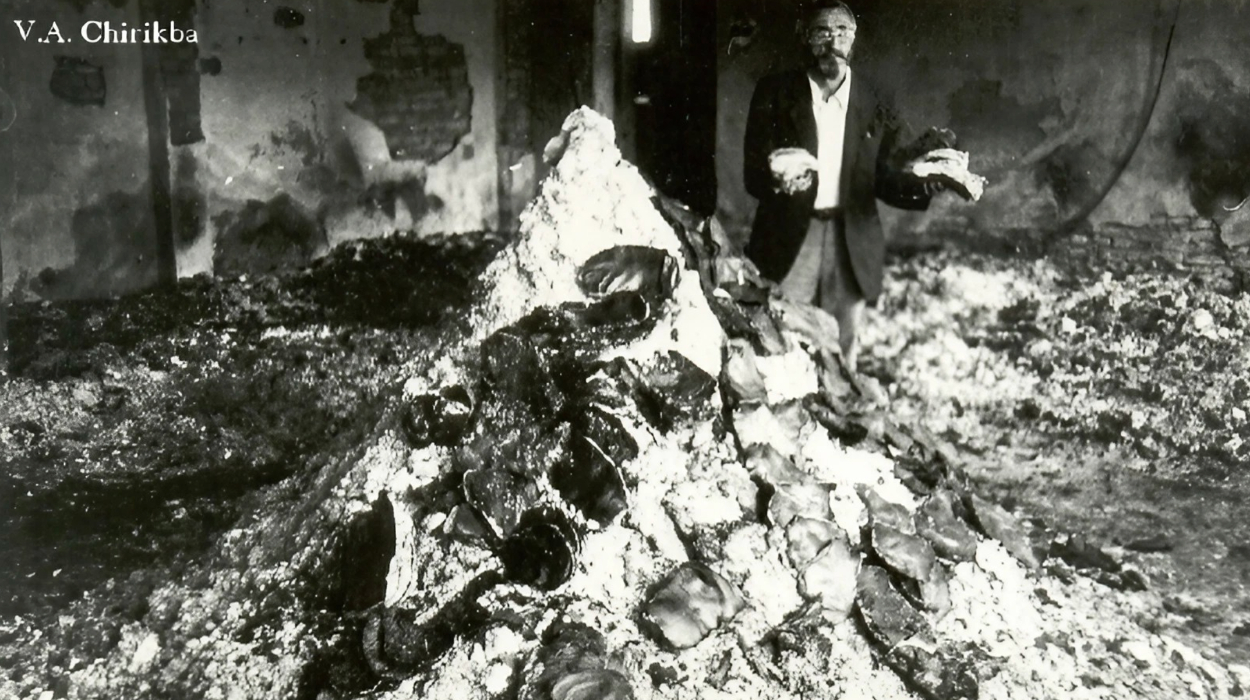
SUKHUM / AQW'A ― On 22 October 1992, two months into the Georgian occupation of Sukhum, armed men set fire to the State Archive of Abkhazia and the Dmitry Gulia Abkhazian Research Institute. Roughly 95 per cent of the country's documentary record, covering 1810 to 1980, was destroyed. Thirty-four years later no one has been brought to account, and archivists are still recovering what survived on microfilm.
Today, 22 October 2026, marks 34 years since Georgian forces burned the State Archive of Abkhazia and the Dmitry Gulia Abkhazian Research Institute of Language, Literature and History. The fires were set in the centre of an occupied city, well away from the front line on the Gumista. In a single afternoon they destroyed most of the written evidence of Abkhazia's modern history.
The attack came two months after the National Library of Bosnia and Herzegovina in Sarajevo was shelled and burned in August 1992. Sarajevo drew the world's attention and international help with restoration. Sukhum drew almost none.
Two fires, one afternoon
By October 1992, Sukhum had been under the control of the Georgian State Council's forces since mid-August, and a curfew was in force. Late in the afternoon of 22 October, a car without number plates drew up outside the State Archive, which stood beside two disused churches in what is now Abazinskaya Street. The men inside were Georgian National Guardsmen; eyewitness accounts put their number at four to six, and some recall the black uniforms of the military police. They shot the doors open and set the building alight, by one account throwing incendiary grenades into the hall and stairwell.
Neighbours of every nationality, Georgians among them, came out and put the fire out. About forty minutes later the armed men returned. This time they fired shots to scatter the crowd, cordoned off the building, doused it in kerosene and lit it again. A fire engine that arrived to help was turned away. The Greek eyewitness Kharalombos Politidis saw Sukhum residents try, and fail, to break through the guardsmen's cordon to rescue burning books and papers. Calls to the police, the KGB and even the Orthodox bishop achieved nothing.
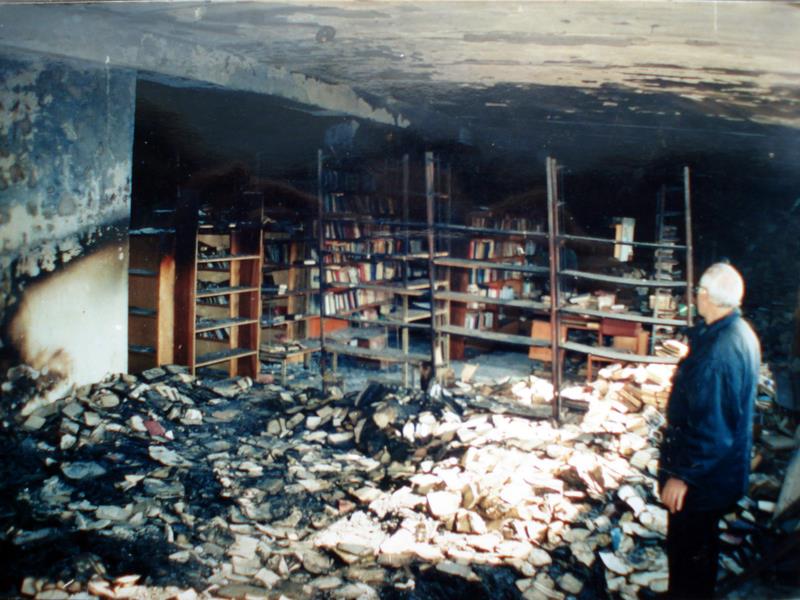
National Library of the Republic of Abkhazia. Boris Cholaria, library director.
The same afternoon, soldiers set fire to the Institute on the seafront embankment. A crowd gathered there too and was dispersed with gunfire; the archaeologist Nikolai Shenkao, a museum employee, was wounded. Witnesses later said the soldiers raked through the archive's ashes for days afterwards with iron hooks, making sure nothing legible survived.
The director of the archive, Nikolai Ioannidi, a Pontic Greek who had run it for decades, heard the news by telephone at eight that evening but could not cross the city until morning. 'In the morning there were just remnants,' he later told the journalist Thomas de Waal. In his own office he opened the safe to find his unpublished manuscripts apparently intact. As he watched, they crumbled to ash from the trapped heat. Among the onlookers that morning was the ethnographer Shalva Inal-Ipa, who bowed his head to the ground in the manner of an Abkhaz mourner at a funeral.
What was lost
At the start of the war the archive held 176,343 files in 673 collections, and about 160,000 of them were destroyed. Ioannidi's own estimate was 168,000 out of 176,000. The records ran from Abkhazia's entry into the Russian Empire in 1810 to around 1980. Nothing survived from the nineteenth-century holdings, which included some 17,000 storage units on the period of Russian annexation, land disputes and peasant risings, schools and medicine, church affairs and the introduction of tobacco and subtropical crops. The Soviet-era collections and the records of the Second World War went with them. So did the files of the resettlement agencies that moved tens of thousands of people from Georgia into Abkhazia, which documented how the republic's population was changed by design.
The archive also held the history of Abkhazia's minorities. The entire record of some 45 Greek communities was lost, including the only complete run of the Pontic Greek newspaper Kokkinos Kapnas, together with papers on the Estonian settlers. A report later compiled in Athens, cited by Neal Ascherson in Black Sea, summed it up: 'the history of the region became ashes'.
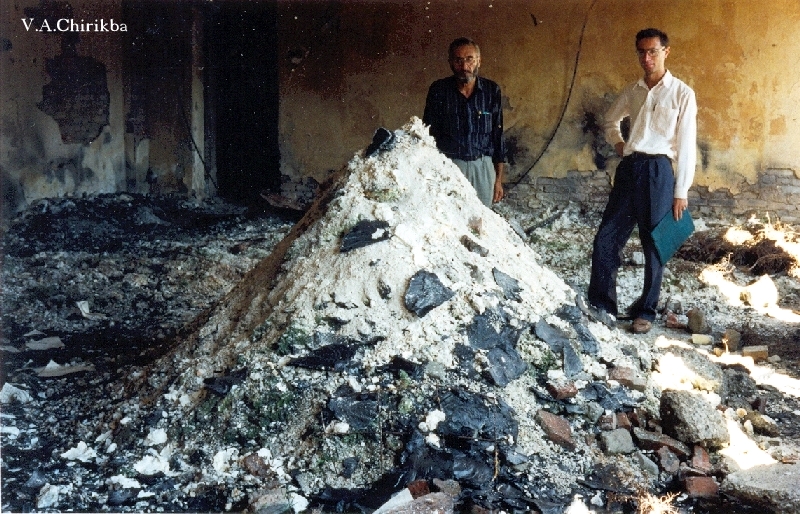
The Institute's losses were of a different kind but just as hard to replace. About 150,000 volumes from its library burned, among them the 1837 Paris atlas of Frédéric Dubois de Montpéreux and the twelve volumes of the Caucasian Archaeographic Commission's Acts. Its run of Abkhazian newspapers since 1917 was lost. So were the personal papers of a generation of scholars, among them Georgy Dzidzaria, Shalva Inal-Ipa, Mikhail Trapsh, Lev Solovyov and Konstantin Shakryl. More than 90 boxes of archaeological finds were destroyed, including material from the excavated necropolis at Tsibilium (Tsebelda), the largest in western Transcaucasia with over 500 graves, along with a collection of more than 50 Venetian glass vessels.
The State Theatre and the State Museum were also marked for burning, but they were spared. The museum was looted instead.
The National Library was not burned on 22 October, but the war devastated it as well. Before 1992 Abkhazia had 421 working libraries holding 7.5 million books. Five were still functioning when the war ended. Almost 40 per cent of the national stock had burned, including some 6,000 rare volumes on Abkhazia's history, and the card catalogues that might have recorded what was lost went too.
Within two days Tbilisi was telling foreign audiences that the Abkhaz had burned their own institutions to discredit Georgia. A version circulated that Abkhaz on hang-gliders had flown in to set the fires. Arda Inal-Ipa, the scholar's daughter, has recalled a meeting of Abkhaz and Georgian intellectuals in Moscow during the war at which a well-known Georgian writer advanced the same claim.
The evidence points the other way. In November 1992 a mission of the Unrepresented Nations and Peoples Organization concluded that the destruction of buildings and materials of historical importance to the Abkhaz amounted to 'an organized attempt to destroy Abkhazian culture and national identity'. Eyewitnesses later told Abkhazia's prosecutors that they recognised among the arsonists members of the Sukhum military police and of the personal guard of Tamaz Nadareishvili, head of the Georgian-installed administration in Abkhazia.

Dmitry Gulia Abkhazian Research Institute of History, Language and Literature
What survived
Not everything was lost. Before the war, the archive had copied its most valuable documents onto microfilm and stored the films as an insurance fund in the two churches next door. The arsonists either did not know this or did not care, and the churches were left standing. For years after the war the films could not be read, because there was neither the equipment nor the specialists to do it. Their inventories had burned with everything else.
Ioannidi kept what remained in his ninth-floor flat, and later in two cold corridors of the university, until a new generation could take over. In the 2010s the question of the archive was raised at the Geneva International Discussions. With European Union funding, the State Archive was equipped to read and scan the films, Czech restoration specialists trained students from Abkhazian State University, and two complete collections were rebuilt: those of the Council of People's Commissars and of the People's Commissariat of Education. Over one 18-month stretch more than 4,000 documents were restored. The archive now works from the rebuilt former Pedagogical Institute and takes requests online. Its director, Roman Gvindzhia, warned in 2022 that outside support for the work was coming to an end.
+ Vandals of the end of the XXth century, by Ermolay K. Adzhindzhal
+ The National Library of Abkhazia: Problems, Searches, Solutions, by Boris Cholaria
+ 22 October 1992: Burning of the National Archives and Library of Abkhazia by the Georgian invaders
+ History on fire: how to restore the state-archive of Abkhazia
No one held to account
A criminal case was opened in Abkhazia in 2006 after a complaint by the historian Ermolay Adzhindzhal, who had worked at the burned Institute. It was later suspended. No one has ever been charged. Adzhindzhal, who gathered ashes from the archive in small labelled bags and sent them to museums abroad, has long argued that 22 October should be marked as a day of mourning for Abkhazian scholarship, and that Georgia should return the Abkhazian archival material held in Tbilisi, Kutaisi and elsewhere.
Thirty-four years on, the site of the old archive is a memorial without a memorial. Every Abkhazian historian writing about the nineteenth or twentieth century still works around the gap that opened on that afternoon.